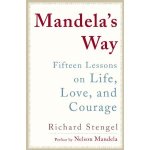
 Richard Stengel, Mandela’s Way: Fifteen Lessons on Life, Love and Courage (New York: Crown, 2010). $23.00, 256 pages.
What would Nelson Mandela do?
Toward the end of Mandela’s Way, Richard Stengel asks this question. Stengel helped Mandela write his autobiography, Long Walk to Freedom, in the early 1990s, and this question helped him “internalize [Mandela] and his ideas.” Mandela’s Way is biographical, but with a moral point. How can reflecting on the life of Nelson Mandela help us live?
The tradition of biography as moral exercise is as old as the Greeks and Romans, not to mention Jews and Christians, but it has taken new form with the uniquely American literary genre of Leadership Secrets of X, usually some famous person. When I picked up Mandela’s Way, I was hoping for the older form of the tradition but worried that I would get the newer one. Few things are more aggravating than the simplification of a person’s life for the purpose of making the reader a better businessman. Stengel, thankfully, did not disappoint me.
As a college student in the late 80s and early 90s, I was aware of Mandela and the struggle of the African National Congress and others to end South African apartheid. I knew little about the man, however. Mandela’s Way is an excellent introduction to his life and struggle, presented thematically rather than chronologically. If one metric of a book’s quality is that it inspires you to read more on the subject, then this book is quite successful.
The subtitle of Stengel’s book is Fifteen Lessons on Life, Love and Courage. My guess is that Stengel’s publisher came up with this verbiage, as a nod to the newer form of moral biography. The lessons are simple—“Courage is not the absence of fear,” “Lead from the front,” “Lead from the back,” etc.—without being simplistic. The way Stengel achieves this is by rooting each lesson in the context of Mandela’s life, struggle, and self-reflection.
Prison dominates the narrative. Mandela spent three decades in South African prison. It molded him as a man and as a leader. It also cost him personally in many ways. Stengel takes measure of both the good and the bad in his portrait of Mandela’s life. What emerges is a man who is morally tough, politically pragmatic—except on the all-important issue of a racially just South Africa, and personally resilient. Mandela’s story inspired me.
“What would Nelson Mandela do?” reflects, whether consciously or not, a phrase popularized by American evangelicals: “What would Jesus do?” As a Christian and as a pastor, what strikes me is the absence of religion in Mandela’s life. He is, according to Stengel, “a materialist in the philosophical sense.” He believes that there is “no destiny that shapes our end; we shape it ourselves.” Of course, he aligned with religious leaders such as Bishop Desmond Tutu, but without sharing their faith. And of course, the Afrikaner architects of apartheid were the progeny of the South African Reformed churches.
Which leads to this irony: Opponents of apartheid asked “What would Nelson Mandela do?” precisely because its proponents did not ask, or did not answer rightly, “What would Jesus do?”
—–
P.S. If this review was helpful to you, please vote “Yes” on my Amazon.com review page.

 GeorgePWood.com
Leave a reply to Howard N. Kenyon Cancel reply