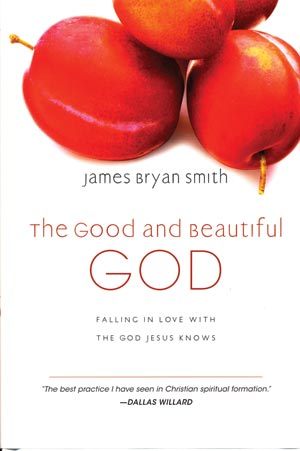
With The Good and Beautiful God, James Bryan Smith inaugurates a three-volume “curriculum for Christlikeness. Volume 2, The Good and Beautiful Life, will focus on “inward character, dealing specifically with the vices that cause ruin.” Volume 3, The Good and Beautiful Community, will focus on learning “how to live as apprentices of Jesus in our ordinary, everyday lives.” Volume 1, reviewed here, focuses on “the character of God and how we move into a life of intimacy with God.”
The nexus between who God is, how we live, and to whom we relate lies at the heart of what Smith believes is “a reliable method for changing our hearts.” All of us—whether Christians or not—desire to become better people. But we rely on willpower to do this, when the real problem lies in our hearts. If change is to happen, our hearts must change, but we cannot do this directly. Rather, as Bryan puts it, “we change by indirection.” Or, put another way: “We do what we can in order to enable us to do what we can’t do directly.”
But even this way of stating the matter places too much emphasis on what “we can do.” In reality, as Bryan points out, is the Holy Spirit who is at work in us, directing our changed narratives, practices and relationships. “Everything that happens to us in our Christian lives,” he writes, “is the work of the Holy Spirit.” The fruit of the Spirit in our lives is becoming what God created us to be and what Jesus re-created us to be.
The Good and Beautiful God examines the stories we tell about God, contrasting them with the stories Jesus told about him. It turns out that our narratives about God lie at the root of our soul-sickness and inability to change.
For example, with heartbreaking honesty, Smith tells the story of Madeline, his first child, who was born with a rare chromosomal disorder that eventually took her life at age two. During that time, Christian friends “said some outrageously ignorant and tactless things to us [Smith and his wife].” Some of them revolved around the notion that Madeline’s disorder must have been caused by some sin in the life of Bryan or his wife.
This narrative of “the angry God”—“God is an angry judge. If you do well, you will be blessed; if you sin, you will be punished”—is prevalent among Christians. But it is directly contradicted by the narrative Jesus tells about God, namely, that he is good (Matthew 19:17), and that sickness is not the result of sin (John 9:2-3). The false narrative “allows us to live in the illusion that we can control our world, which is very appealing in our chaotic existence.” Jesus’ narrative requires us to trust in God, even though the world is not always good, although sometimes—of course—it is. Smith concludes, “My own experiences of disappointment with God say more about me and my expectations than they do about God.” And, “I have grown much more through my trials than I have through my successes.” Only faith in God’s essential goodness can sustain that hopefulness in the face of tragedy over a lifetime.
In addition to God’s goodness, Smith talks about God being trustworthy, generous, loving, holy, self-sacrificing, and transformative. Each chapter exposes a false narrative about God that distorts some aspect of his character, and offers a “soul-training exercise to help imbed the narrative of Jesus more deeply into our minds, bodies and souls.”
I read The Good and Beautiful God in solitude, but it is designed to be read in community. In addition to the soul-training exercises, the book includes a discussion guide. The book is ideal for use in Sunday school classes, small groups, and book clubs. Because it contrasts false and true narratives about God, I think it would even be useful in small groups that have an evangelistic purpose.
In conclusion, I have described the book, but let me briefly describe its effect on me. Like many other Christians, I have mental narratives about God that don’t jibe with the God and Father of Jesus Christ. This book patiently, biblically, theologically, and spiritually showed me once again that God is good and beautiful. It left me wanting to know that God better and to live more for him.
—–
If you found this review to be helpful, please vote “Yes” on my Amazon.com page.
 GeorgePWood.com
Leave a comment