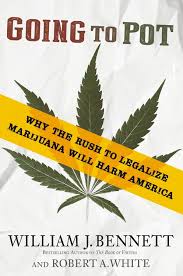
 William J. Bennett and Robert A. White, Going to Pot: Why the Rush to Legalize Marijuana Is Harming America (New York: Center Street, 2015). Hardcover | Kindle
“We are at a curious, as well as critical, moment in our country,” write William J. Bennett and Robert A. White in their new book, Going to Pot. “We are spending money and political capital on strengthening the health, education, and productivity of our populace, yet society believes it appropriate to push for greater availability of a drug that hinders, and negatively affects (perhaps dramatically), those very efforts.” That drug is marijuana.
Americans’ sea change of opinion on marijuana legalization has been slow but dramatic. In 1969, when Gallup began polling the issue, 84 percent of Americans opposed legalization, 12 percent supported it. By 2013, however, 58 percent supported it, 39 percent opposed. Support fell back to 51 percent in 2014, but the overall trendline is clear: Americans support marijuana legalization. Given that younger adults (ages 18 to 29) overwhelmingly support legalization—at 67 percent—proponents of continued marijuana prohibition face an uphill battle both in public opinion and at the polls.
Bennett and White’s main goal in writing Going to Pot is “to stop the juggernaut of legalization.” Their argument against it focuses on raising public awareness of two issues: “the higher potency of today’s marijuana” and “the ever-increasing body of scientific evidence documenting the many adverse consequences of smoking marijuana.”
Regarding potency, Bennett and White write: “The average amount of THC in marijuana today, the primary psychoactive ingredient in the drug, is about 9.6 to 13 percent, more than double the potency of marijuana in 1983, which was more than double what it was the decade before.” Researchers at the University of Mississippi have identified strains with THC levels of 37 percent.
Increased potency levels entail that “there really are two different conversations taking place,” the authors write. “One is based on a frame of reference of marijuana that was experienced in the past, was weaker, and does not exist today.” This is the pro-legalization argument used by Baby Boomers who smoked joints back in the 1960s. “The other is based on the reality of marijuana that is grown, processed, and sold today.”
Regarding the use of higher potency marijuana, Bennett and White cite a number of medical and scientific studies to document its adverse health effects. They include a 2014 study from The New England Journal of Medicine (NEJM) at the end of the book because its results typify what the other studies show.
Titled, “Adverse Health Effects of Marijuana Use,” the study concludes, “Marijuana use has been associated with substantial adverse effects, some of which can be determined with a high level of confidence.” It goes on to say, “Marijuana, like other drugs of abuse, can result in addiction. During intoxication, marijuana can interfere with cognitive function (e.g., memory and perception of time) and motor function (e.g., coordination), and these effectives can have detrimental consequences (e.g., motor-vehicle accidents). Repeated marijuana use during adolescence may result in long-lasting changes in brain function that can jeopardize educational, professional, and social achievements.” (The mention of adolescent marijuana use should remind us that while legalization is intended for adult use, the unintended consequence is increased use by minors. They are legalization’s primary victims.)
The authors acknowledge that THC has legitimate medical uses, such as “cachexia, multiple sclerosis spasticity, and vomiting [associated with chemotherapy],” among others. Unfortunately, the primary users of marijuana in states with medical marijuana laws do not indicate these conditions.
For example, according to a December 2012 report by the Arizona Republic, “3.76 percent [of the states 34,000 medical marijuana cardholders] use marijuana to ease the symptoms of cancer. Another 1.53 percent suffer from glaucoma while 1.06 percent have AIDS.” These seem to be legitimate uses. “Meanwhile 89.8 percent—30,203 people—are seeking relief for ‘severe and chronic pain.’” The demographics of these users skew overwhelmingly to young men: “nearly 73 percent of patients are men and the people most likely to seek relief from pain are 18 to 30 years old.” This demographic skew is statistically suspect. One would expect a more even distribution between men and women, for one thing. For another, one would expect older patients to experience more pain than younger ones. That neither of these expectations are realized probably indicates that young men are using medical justifications to obtain legal access to a drug they use recreationally. In other words, they’re gaming the system.
In light of both legitimate medical use and widespread abuse, Bennett and White suggest a medical protocol by which government agencies could monitor the use of medical marijuana to make sure that it is going to the people who need it. Absent such a protocol, medical marijuana is a farce, a foot in the door for legalization’s traveling salesmen.
At the end of the day, the question of marijuana legalization comes down to costs vs. benefits. Opponents such as Bennett and White argue that the costs of legalization—the social costs of marijuana’s adverse health effects—outweigh any benefits; so American public policy should continue to prohibit marijuana use (with allowances for genuine medical need). Proponents argue the opposite: Like alcohol and tobacco—substances that also have adverse health effects—marijuana should be legally available.
The NEJM study notes the danger in the proponents’ comparison: “legal drugs (alcohol and tobacco) offer a sobering perspective, accounting for the greatest burden of disease associated with drugs not because they are more dangerous than illegal drugs but because their legal status allows for more widespread exposure. As policy shifts toward legalization of marijuana, it is reasonable and probably prudent to hypothesize that its use will increase and that, by extension, so will the number of persons for whom there will be negative health consequences.” Or, as Bennett and White put it, legalizing marijuana “will simply add one more product to the marketplace of damage done to individuals and society.”
Do we really need that? The question seems to answer itself.
P.S. If you found my review helpful, please vote “Yes” on my Amazon.com review page.


 GeorgePWood.com
Leave a comment