Thanksgiving Jujitsu (1 Corinthians 1:5-6)
When I was growing up, my dad often said, “Your greatest strength is your greatest weakness.” I read a lot and love to debate ideas, for example. As a pastor, I’m prepared to debate people who are skeptical of Christianity and use arguments to buttress their skepticism. Unfortunately, I’m also prone to pick intellectual fights and be censorious of others’ doubts. (Less now, I’m happy to confess, than when I was younger.)
If your greatest strength is your greatest weakness, than your greatest weakness is also your greatest strength. In 1 Corinthians 1:4-9, Paul gave thanks for the grace God had given the Corinthians through Jesus Christ. Verses 5-6 identify a very specific reason for Paul’s gratitude:
“For in him you have been enriched in every way—in all your speaking and in all your knowledge— because our testimony about Christ was confirmed in you.”
Let’s focus on just nine words: “in all your speaking and in all your knowledge.” In Greek, the words for speaking and knowing are logos and gnosis, respectively. According to Gordon Fee, “Both terms occur far more often in 1 and 2 Corinthians than in all the other Pauline letters, and in contexts that make it clear that they are Corinthian terms.”
Positively, both logos and gnosis are spiritual gifts (1 Cor. 12:8, 13:2, 14:6), which the Corinthians had in abundance. And Paul was thankful for these gifts. They were the Corinthians’ greatest strengths.
But they were also the Corinthians’ greatest weaknesses. When we read 1 Corinthians 12-14, we realize that the Corinthians liked to exercise the gift of logos a lot. They delighted in speaking in tongues, which is the gift of speaking in a language you have not learned by natural means (13:1, cf. Acts 2:4-8). Unfortunately, they didn’t bother to interpret those languages so that others could understand what they were saying. Additionally, rather than speaking in an orderly manner, each speaker clambered to the pulpit to speak, even if someone was already there delivering a message. Their logos lacked love for others.
When we read 1 Corinthians 1:10-4:21, we also realize that the Corinthians liked to exercise the gift of gnosis a lot. They loved to listen to speakers who were skilled in the art of rhetoric and who preached messages filled with intellectual profundities. And they liked to imagine themselves as wise and knowledgeable people. The only problem? Their gnosis left out certain inconvenient facts about the cross of Christ, from which flowed all the grace that had come to them. And according to 1 Corinthians 8:1-13, they used their knowledge to do things that offended the weak consciences of other believers. Their gnosis didn’t reflect Christ’s cross-love, and it didn’t practice neighbor-love either.
Paul gave thanks for their logos and gnosis anyway. Why? Because though abused, the gifts were real expressions of God’s grace. They were weaknesses with strengths behind them.
In our dealings with others, let’s practice thanksgiving jujitsu, and like Paul, thank God even for weak strengths.
_____
Book Review: Son of Hamas by Mosab Hassan Yousef
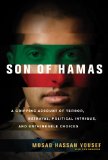 Mosab Hassan Yousef is the son of Sheikh Hassan Yousef. The elder Yousef is one of the founders of Hamas, the militant Islamic group that controls Gaza and seeks the destruction of the state of Israel. For a decade Mosab spied on his father’s organization for Shin Bet, Israel’s internal security agency. One more thing: Three years after beginning to spy for Shin Bet, Mosab began attending a Christian Bible study. He was baptized in 2005…
To finish reading my review of Son of Hamas, click here.
 GeorgePWood.com
Leave a reply to Resources for 1 Corinthians 1:5 – 6 Cancel reply