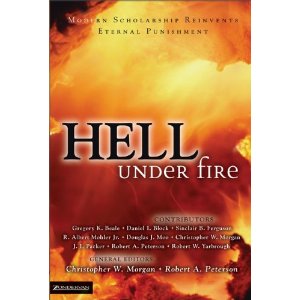
 Christopher W. Morgan and Robert A. Peterson, eds., Hell Under Fire: Modern Scholarship Reinvents Eternal Punishment (Grand Rapids, MI: Zondervan, 2004). $19.99, 256 pages.
The doctrine of eternal punishment is firmly established in both Scripture and the Christian tradition, but it also has its detractors within the church, from Origen in the early third century and Arnobius of Sicca in the early fourth to Thomas Talbott and Edward William Fudge today. The principal alternatives to eternal punishment are universal salvation and the annihilation of the wicked, the former represented by Origen and Talbott, the latter by Arnobius and Fudge. Hell Under Fire is an exegetical and theological defense of the doctrine by evangelical scholars.
In Chapter 1, R. Albert Mohler Jr. traces the disappearance of hell. Though once a staple in both Catholic and Protestant – and especially evangelical Protestant – preaching, hell has been downplayed by modern theologians and preachers. Mohler explains why.
Chapters 2-5 provide exegesis of relevant passages from the Bible. Daniel I. Block examines what the Old Testament teaches about the afterlife. Only two passages – Isaiah 66:24 and Daniel 12:1-3 – clearly articulate a postmortem experience of divine judgment, although many passages speak of or hint at life after death. Nonetheless, the OT material is valuable for understanding how Jews prior to Jesus thought of life after death, and one can see a theological evolution of the doctrine from the OT’s vague statements to the New Testament’s clearer teaching on the subject.
Robert W. Yarbrough (my NT professor at Wheaton College) surveys the Gospels. He opens with a critique of those who doubt that the Gospels accurately convey the teaching of the historical Jesus. He goes on to provide a close exegesis of relevant passages from the Synoptics and John and concludes that they teach the “ceaseless constant torment” of the impenitent, against Fudge’s annihilationist reading of those same passages.
Douglas J. Moose surveys the Pauline epistles. Moo concedes that Paul does not use the terminology of “hell” as Jesus did. Nonetheless, based on what Paul wrote about divine judgment, Moo concludes that Paul believed hell was real, eternal, and retributive in nature.
Gregory K. Beale provides, in my opinion, the book’s densest and most technical exegesis in his study of Revelation. He tracks down the background of John’s visions of hell to the OT and intertestamental Jewish literature, interacts with annihilationist readings of the relevant passages, and concludes that Revelation clearly teaches eternal punishment, hinting that only someone with “a prior theological agenda” could conclude otherwise. Coming as it does in the penultimate paragraph of his chapter, after pages of fair-minded exegesis, Beale’s hint strikes me as very plausible.
To my mind, the single most helpful chapter in Hell Under Fire is Morgan’s (Chapter 6), which offers a broad survey of the NT teaching on hell using its three primary images: punishment, destruction, and banishment. Morgan’s chapter builds upon and frames the previous exegetical chapters. He notes that the NT writers use all three images, sometimes mixing and matching them. The dominant image is punishment, but the other images explain other aspects of hell that the punishment doesn’t capture.
In Chapter 7, Peterson surveys the interrelationship of the doctrine of hell with three other doctrines: (1) the Trinity, (2) divine sovereignty and human freedom, and (3) the NT’s inaugurated eschatology, in which the kingdom of God – both to save and to condemn – is “already” but “not yet.”
Chapters 8 and 9, by J.I. Packer and Morgan, respectively, evaluate the underlying theologies of universal salvation and the annihilation of the wicked, in that order. Packer’s chapter was the weakest in the book, in my opinion. To the extent that they rely on biblical exegesis to ground their belief, universalists cite several passages in Paul, which Packer treats in only a cursory fashion. Thankfully, Moo considers those passages in his own chapter and shows why context rules out a universalist interpretation of them. The real strength of universalism, or rather, its real impetus, is philosophical. Unfortunately, Packer does not do as good a job of dealing with universalist philosophical objections as he could have. A philosopher such as Jerry Walls would’ve done a better job, in my estimation, of answering the universalist arguments of people such as Talbott. I’m not sure why Walls wasn’t asked to contribute a chapter, since he has written a book on hell from the standpoint of philosophical theology. Given the Reformed or Calvinist leanings of the authors of this book, my guess is that including an Arminian such as Walls simply wasn’t on the agenda. To his credit, Packer notes that Calvinists and Arminians – indeed, open theists! – unite in opposing universalism, though for different reasons, of course.
Morgan’s chapter on annihilationism, also known as conditional immortality, takes up five objections to eternal punishment offered by advocates of this alternative position, including the notion that eternal punishment assumes a Platonic or Hellenistic rather than biblical anthropology of the soul’s immortality. As in his earlier chapter on biblical theology, Morgan does an excellent job of working his way through the arguments in a clear, accessible style of writing.
Chapter 10 by Sinclair Ferguson addresses the pastoral uses of the doctrine of eternal punishment. This situates the doctrine in the real life of the church, as pastors evangelize and lead the spiritual formation of their congregations. Isaiah, Daniel, Jesus, Paul, and John do not discuss the doctrine of hell for systematic theological reasons. They preach it in order to warn sinners and motivate repentance. Ferguson refocuses his readers on these important pastoral tasks.
Although Hell Under Fire contains high-level exegesis and systematic thinking, it was not written for academics. Rather, it was written for them, for pastors, and for patient lay readers with an interest in theology. If the Bible teaches the reality of eternal punishment and encourages people to avoid that fate through repentance and faith in Jesus Christ, then Bible-believing Christians should do the same. If you are going to purchase only one book on the doctrine of eternal punishment, this is the one you should buy.
—–
P.S. If you found this review helpful, please vote “Yes” on my Amazon.com profile page.

 GeorgePWood.com
Leave a reply to Rick Lannoye Cancel reply