“Clergy find joy, but plates runneth over”: Evidently, Christian ministers are fat and happy.
A recent study funded by Duke Divinity School found that, on average, ministers make up the chubbiest profession. But this is one of those good news/bad news deals: The good news is that a separate survey by the University of Chicago found that preachers also tend to be the most-satisfied workers.
What message do we—and I really mean we since I’m an overweight minister—send to our congregants when we denounce their sins and overlook our own gluttony? Just asking…
_____
Other Christian traditions also manifest great internal diversity, but Baptists seem to outdo them all. Even to Baptists who have deeply pondered the question, it can be a real puzzle to say what it means to be a Baptist. We have, thus, recent historians who stand back in some perplexity before “the bewildering range of Baptist identities.” Or who conclude: “Neither can Baptists point to a single theological tradition …. Contemporary Baptists are not the product of a single cultural influence.” Or who might seem to run up a white flag: “In the end … the Baptist identity, a phenomenon of the flux of history, may elude definition.”
Against this council of despair, two recently published books suggest that it is possible to find a meaningful Baptist constant in shared history, common affirmations, and religious tendencies. Both Robert Johnson in his encyclopedic A Global Introduction to Baptist Churches and David Bebbington in his textbook primer Baptists Through the Centuries: A History of a Global People recognize the difficulty in isolating a common Baptist theology or social stance or programmatic consensus. But both also make a convincing case for a meaningful degree of continuity in foundational principles or persistent instincts characterizing virtually all Baptist movements.
_____
“Christian Colleges Hope House Bill Will Repeal New Rules”:
Christian colleges are hoping that a bill making its way through the U.S. House of Representatives may resolve their concerns over education regulations that go into effect July 1.
Under the new regulations, created by the Department of Education (DOE) in response to reports of financial-aid fraud at several for-profit institutions, states are required to have a “substantive” procedure to license private schools. For religious universities, this has raised concern that political agendas could be imposed on their missions. (See “New Rules Worry Christian Colleges,” November 1, 2010.)
“My concern is that there appears to be no limit to what factors a state can consider when granting or withholding authorization, and no mechanisms for appeal or due process,” said Blair Dowden, president of Huntington University, at a March hearing before a House committee.
_____
The single-most powerful political action Christians “do” is baptism and Eucharist, for in those actions we enter into an alien politics.
_____
Speaking of aliens: “Jesus Christ, Extraterrestrial?”
I imagine two steps in the Christian response. The first has to do with the idea that creation is good. That’s set forth clearly for both Jews and Christians in scripture. Creation is a good thing, and God has created abundant life. Now, “created” could include evolutionary processes, but the point is that since God is the author of all of it, whatever is there is good.
So, with that theology when we see the abundance of life flourishing on this planet, we could simply broaden our view of God to include life elsewhere. If God is the author of life on countless other worlds, it increases our sense of wonder and appreciation.
The second step is this. In Christian thought, humans have a problem in their personal relationships with God. We’re separated from God by our own sin, we need restoration of that personal relationship, and that restoration has been provided by God becoming human. God became incarnate in the person of Jesus Christ and walked the surface of the earth, guided us, and then died and rose again. That restored our relationship with God.
So if there are other intelligent civilizations out there, how has God interacted with them? Have they sinned? Have they needed redemption? Did Christ visit them in their forms? Or did his work here on Earth suffice for all life everywhere?
We get into a conundrum about the exact work of Jesus Christ on this planet and how it could pertain to life all over the cosmos. That’s particularly important in Christianity, because it’s really only humans in Christian theology who have this problem of sin. That’s where we get into a really interesting theological case.
Interesting.
_____
“Reading Scripture with Sex Abuse Survivors.” I’m not sure I would recommend Trible’s book, as this reviewer does, but Webb’s book is a definite thumbs up.
_____
“Wired pastor says unplug.” I hearing and reading that a lot nowadays.
_____
“The Presence of God in Fred Rogers’ Life and Work.” He certainly got the “love your neighbor” part right. Speaking of which, won’t you be my neighbor?
_____
“Atheist flying ad campaign meets strong resistance.” It’s almost as if atheists need to take a course in effective…evangelism. Have these people never heard of The Gospel Blimp. What’s next? Annoying door-to-door campaigns with the Four Unspiritual Laws?
_____
“A church by any other name…”:
While Living Faith’s story might be uncommon, it is not unique. The seemingly mundane topic of a church name has become a flashpoint for U.S. congregations, with many renaming themselves in recent years for pragmatic, theological or even cultural reasons.
_____
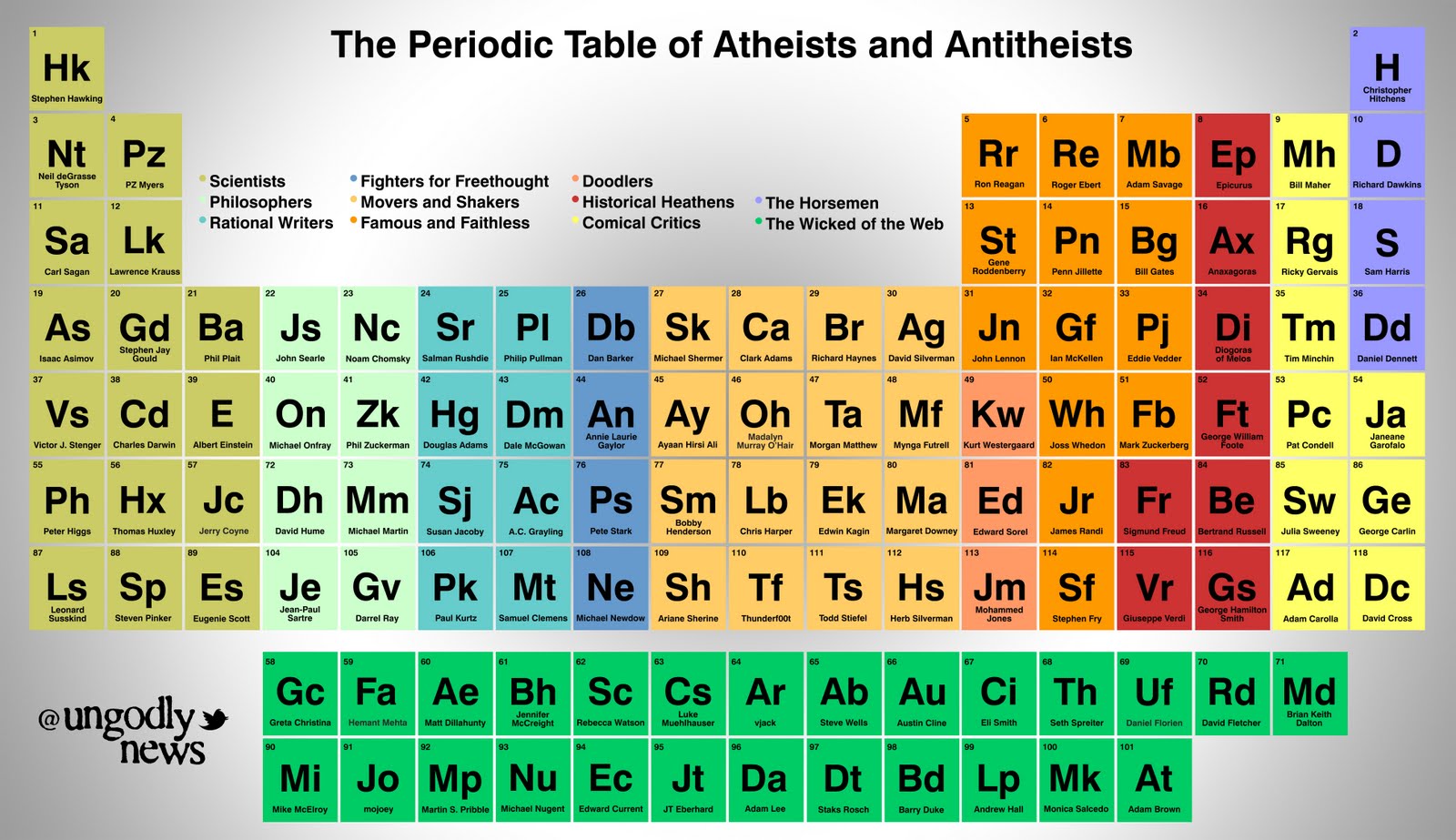
“The Periodic Table of Atheists and Antitheists”:

 GeorgePWood.com

Leave a reply to Howard N. Kenyon Cancel reply