The Protestant Reformation marks its five-hundredth anniversary this coming October 31st. On that date in 1517, Martin Luther posted his Ninety-five Theses on the door of the Castle Church in Wittenberg. The theses called into question the selling of indulgences, which the pope granted to reduce time in Purgatory for either the buyer or the buyer’s intended beneficiaries.
“As soon as the coin in the coffer rings,” preached Johannes Tetzel of these indulgences, “the soul from purgatory springs.” Sales of indulgences were quite lucrative, helping Albert of Brandenburg buy the archbishopric of Mainz and Leo X build St. Peter’s Cathedral in Rome. The text of the Ninety-five Theses was largely biblical and theological, but the subtext was a German critique of Italian grandiosity.
Luther intended his theses to instigate a “disputation…on the power and efficacy of indulgences,” as the incipit to the printed placard put it. He didn’t intend to divide the Church or rend the unity of medieval Europe. Like many of his contemporaries, he wanted to reform Catholicism and restore the simplicity of the gospel. Dissemination of his theses set in motion a process which did that, though in ways he could not foresee that All Hallows’ Eve. After Luther, Christianity and Christendom would never be the same. We moderns live in his world-historical shadow.
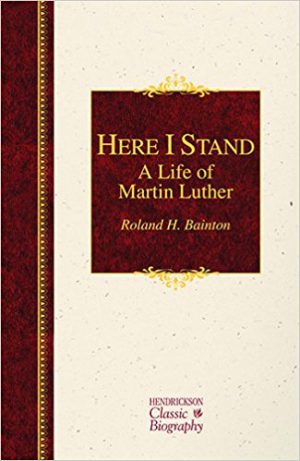
Here I Stand by Roland H. Bainton narrates the events of Luther’s life, focusing on the years between the posting of the Ninety-five Theses in 1517 and the publication of The Augsburg Confession in 1530. Though Luther was born in 1487 and died in 1546, 1517–1530 is the crucial period. Luther’s theology matured: he defined the doctrine of justification by faith, translated the New Testament, revised the liturgy, and wrote catechisms for adults and children alike. It was also during this period that Luther broke decisively with Rome; the Evangelicals divided into Lutheran, Reformed, and Anabaptist camps; and Christian princes intervened in political disputes, protecting the nascent Lutheran movement. In these years, religious radicals took over Müntzer, German peasants revolted and Luther’s theology of both church and state advocated a middle way between extremes.
Bainton’s prose is clear and his narrative forward-moving. Here I Stand is a work of genuine scholarship—with a chronology, bibliography, and index—but it is written for a broad audience. If you’re interested in Luther’s life, or the history of the Reformation, I encourage you to read this biography first.
Here I Stand was first published in 1950, but I read the 2009 reprint in the Hendrickson Classic Biography series. It is available as a reprint from other publishers too.
Book Reviewed:
Roland H. Bainton, Here I Stand: The Life of Martin Luther (Peabody, MA: Hendrickson, 2009; orig. 1950).
P.S. If you found my review helpful, please vote “Yes” on my Amazon.com review page.

 GeorgePWood.com
Leave a reply to Martin Luther | Book Review – GeorgePWood.com Cancel reply