American organized religion is declining. According to Gallup data, only one percent of U.S. adults claimed no religious affiliation in 1955. By 2017, that percentage had grown to 20. The younger the adult, the likelier the lack of religious affiliation. For adults ages 30–39, the percentage is 28. For those ages 21–29, it’s 33. If you’re looking for evidence of secularization in America, this rise of the Nones is Exhibit A.
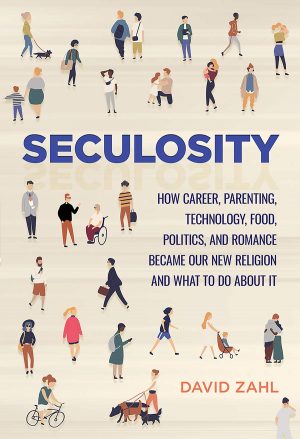
And yet, David Zahl claims inhis new book that “the marketplace in replacement religion is booming.” Those replacements don’t look or feel religious, however — at least not in the capital-R sense of the term, which Zahl describes as “robes and kneeling and the Man Upstairs.” They don’t necessarily look like “folkloric beliefs” or “occult belief systems” either: things like charms, telepathy, or astrology.
Instead, replacement religions center around everyday concerns such as — to list the topics of the book’s chapters — busyness, romance, parenting, technology, work, leisure, food, and politics. Zahl calls each of these replacements “seculosity,” a portmanteau of “secular” and “religiosity.” Seculosity is a religious impulse “directed horizontally rather than vertically, at earthly rather than heavenly objects.”
Why does Zahl considers these secular concerns religious? And why should we do so too? Those are fair questions, good ones even, because they go straight to the heart of what our culture thinks religion is.
We typically think of religion in of capital-R Religion terms, that is, organized religion with its concerns for doctrine, ritual, community, and institutions. Those are the outward manifestations of an inward impulse, which Zahl calls “the justifying story of our life.” According to him, religion is “what we lean on to tell us we’re okay, that our lives matter.” It is “our preferred guilt-management system.” In other words, religion is what “we rely on not just for meaning or hope but enoughness.” This search for enoughness characterizes religious Nones just as much as it does the traditionally religious. It is a universal longing.
Take the everyday concern about busyness, for example. Ask people how they’re doing, and they’ll probably reply, “Busy.” I certainly would. Between work, marriage, parenting, and life in general, it feels like every moment of every day is accounted for…and then some. I tell myself to rest, but the moment I start to do so, the nagging suspicion takes hold that a book needs to be read, an article needs to be written, a chore needs to be accomplished, my kids need to be helicoptered over, my wife needs to be date-nighted, the latest blockbuster movie needs to be watched, etc. (Notice, by the way, that even our leisure activities such as dating and movie-watching become have become to-do items.)
These nagging suspicions arise from what Zahl calls “performancism.” He writes: “Performancism turns life into a competition to be won (#winning) or a problem to be solved, as opposed to, say, a series of moments to be experienced or an adventure to relish. Performancism invests daily tasks with existential significance and turns even menial activities into measures of enoughness.”
And woe betide those who fail at these tasks, because “if you are not doing enough, or doing enough well, you are not enough.” Zahl doesn’t quote Blaise Pascal at this point, but there’s a lot of wisdom in the latter’s statement, “All of humanity’s problems stem from man’s inability to sit quietly in a room alone.” (Now that I’ve quoted Pascal, however, I’m feeling guilty that I’m not checking off that to-do item either.)
Performancism is “one of the hallmarks of all forms of seculosity,” their underlying assumption, affecting how we approach everyday life. It cripples seculosity’s practitioners with anxiety (Am I enough?), shame (Do they think I’m enough?), and guilt (Have I done enough?). “The common denominator [in all forms of seculosity] is the human heart, yours and mine,” Zahl explains, referring to what motivates our behavior. “Which is to say, the problem is sin.”
In theological terms, you see, seculosity is just the latest example of a “religion of law.” It is a form of self-justification or works-righteousness. And like all such schemes, it is doomed to failure because “all have sinned and fall short of the glory of God” (Romans 3:23). We are not enough. We have not done enough. We cannot do enough.
The antidote to seculosity is a “religion of grace,” Zahl concludes. “Sin is not something you can be talked out of (‘stop controlling everything!’) or coached through with the right wisdom. It is something from which you need to be saved.” And that salvation depends on the sacrificial love of the One doing the saving. He is enough, and only in Him can you be too.
Book Reviewed
David Zahl, Seculosity: How Career, Parenting, Technology, Food, Politics, and Romance Became Our New Religion and What To Do About It (Minneapolis, MN: Fortress Press, 2019).
P.S. If you liked my review, please click “Helpful” on my Amazon review page.
P.P.S. This review is from the July-August 2019 print issue of Influence magazine and is cross-posted here with permission.


 GeorgePWood.com
Leave a reply to georgepwood Cancel reply