Every morning, I recite the Nicene Creed (A.D. 325/381) during my devotions. The creed outlines doctrines all branches of Christianity affirm, especially the Trinity and Incarnation.
Reciting the creed may seem strange to Pentecostals. In our theologizing, we often ignore or downplay the Great Tradition — Christianity’s historic creeds and confessions — opting instead for a proof-texting approach.
The problem with ignoring the Great Tradition is needlessly refighting old battles. The “New Issue” among first-generation Pentecostals seems like a recapitulation of third- and fourth-century Trinitarian debates, for example.
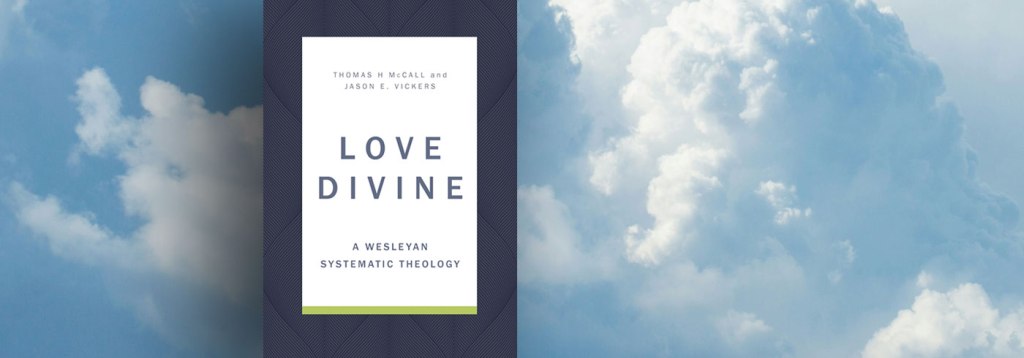
In Love Divine, Thomas H. McCall and Jason E. Vickers offer a systematic theology framed by the Great Tradition, imbued with Wesleyan convictions and informed by Wesleyan sources.
McCall and Vickers define systematic theology as the study of God characterized by conceptual organization, relative comprehensiveness, and logical coherence.
“We are committed to theology that is grounded in Scripture and always accountable to it, faithful to the catholic [i.e., universal] tradition of creedal orthodoxy, firmly Protestant and evangelical, and distinctly and unapologetically Wesleyan,” the authors write.
Chapters 1 and 2 examine theology proper, specifically “the concept and nature of deity” and “God’s personal name and identity,” respectively.
McCall and Vickers advocate classical theism, which ascribes to God “perfections” such as simplicity, omnipotence, omniscience, eternity, omnipresence, goodness, and especially love.
The authors also affirm classical Trinitarianism, in which the one Being eternally subsists in three Persons — Father, Son, and Holy Spirit.
Chapters 1 and 2 end with a discussion of love. Scripture teaches “God is love” (1 John 4:8). This means that “love — holy love, the self-giving and pure love shared between Father, Son, and Holy Spirit in their mutual relations — is at the center of all reality,” the authors write.
Chapters 3 and 4 turn to what God does, focusing on creation and providence.
God freely creates a good world ex nihilo, “out of nothing.” This understanding rules out explanations of the universe that dismiss the Creator-creature distinction (naturalism, pantheism); attribute necessity rather than contingency to creation (panentheism); or deny creation’s inherent goodness (Gnosticism, Manichaeism).
Quoting John of Damascus, McCall and Vickers define providence as the “care that God takes over existing things.” They focus on providence as conservation of creation, concurrence of divine actions with creaturely actions, and sovereign government.
Scripture portrays God working in history, “even using the actions of human wickedness and sin for his own good purposes” (e.g., Genesis 50:20; Acts 2:23). The distinction between divine goodness and human wickedness informs Christian thinking about the problem of evil. God is not the author of evil; we are.
Chapters 5 and 6 turn to the nature and condition of humans. Though made in God’s image, we have fallen into sin and need God’s grace.
At the popular level, total depravity is associated with Calvinism. Traditionally, Wesleyans also have affirmed it, however. The doctrine means sin “impacts every aspect or faculty of human life,” individually, socially, and structurally. Sin renders us unable to save ourselves.
Our loving God refuses to leave us in sin, however. Chapters 7, 8, and 9 examine election, the Incarnation, and Christ’s saving work as God’s response to our sin.
Many Christians associate election and predestination with Calvinism. In Calvinism, God unconditionally elects some (not all) to salvation, and the effect of Christ’s atoning death is limited to the elect.
Unconditional election and limited atonement constitute a minority report in the Great Tradition and a particular concern for Wesleyans. Charles Wesley even wrote a 15-verse hymn titled “The Horrible Decree” to refute the doctrines.
Love Divine engages these doctrines in Chapter 7 from a Wesleyan-Arminian standpoint. Contrary to Calvinism, election is conditional on foreknowledge. God predestines those He knows will respond in faith when offered the gospel (Romans 8:29).
And atonement is not limited. Jesus Christ is “the atoning sacrifice for our sins, and not only for ours but also for the sins of the whole world” (1 John 2:2).
Atonement happens only because of the Incarnation, the focus of Chapter 8. The Nicene Creed affirmed Jesus Christ’s divinity and humanity.
The Council of Chalcedon (A.D. 451) clarified how those two natures coexisted in one Person “without confusion, without change, without division, without separation.” These distinctions rebutted various Christological heresies.
McCall and Vickers emphasize that more is at stake than punctilious orthodoxy. “These key elements of Christology … are absolutely central to the good news of the Christian faith. God is for us. God is with us. Completely and unreservedly.”
The Nicene Creed says God’s Son became incarnate “for us and for our salvation.” Chapter 9 examines this saving work as revealed in the Incarnation, Christ’s life and teaching, His suffering and death, and His resurrection and ascension.
Salvation is objective and subjective, justification and sanctification. Christ reconciles us to God and leaves a moral example to follow. But if sanctification is salvation and we cannot save ourselves, how do we become holy?
Through the Holy Spirit poured out by our ascended Savior.
The person and work of the Spirit are the subjects of Chapters 10 and 11.
In the Nicene Creed, the Son is “begotten” by the Father, but the Spirit “proceeds” from the Father. Centuries later, the Latin-speaking church added “and the Son” (filioque), precipitating a schism from the Greek-speaking church. These phrases define the order of relations between the Persons of the Trinity.
McCall and Vickers suggest love is distinctive of the Spirit’s identity, both in intra-trinitarian relations and in relationship to humanity: “The Holy Spirit gives lots of gifts to believers, but the greatest gift by far — the gift that really matters — is the gift of love” (1 Corinthians 13:13).
Chapter 11 focuses on the work of the Holy Spirit from creation to new creation. Its primary focus is “the ways in which the Spirit actualizes in us all the benefits of Christ’s atoning work, including overcoming the separation, alienation, and estrangement that result from human sin and sinfulness.”
In line with that focus, the authors discuss the various ways Wesleyan theologians have understood “entire sanctification” and “Christian perfection” in the life of the believer. Interestingly, the debate between “instantaneous” and “progressive” sanctification divided the first generation of Pentecostals into Wesleyan and “Finished Work” camps. The Church of God (Cleveland, Tennessee) and Church of God in Christ are Wesleyan, while the Assemblies of God is “Finished Work.”
McCall and Vickers also discuss how the Spirit facilitates the relationship between the Church and salvation. Specifically, they examine the unity of the Church; the means of grace (Scripture, preaching, baptism, Communion); models of polity; and the Church’s mission.
“Like the Spirit who enlivens her each day, the church’s witness is never to herself, but to Christ alone, who is the foundation and cornerstone upon which her life is built” (Ephesians 2:20–22), the authors write.
Finally, Chapter 12 examines eschatology, focusing on resurrection, the Second Coming, and the Final Judgment.
Classical Pentecostals will appreciate the authors’ evaluation of universal salvation, a topic of intense discussion among contemporary theologians and an issue North American Pentecostals first dealt with during the 1920s. God wills to save all, but not all will be saved.
Although Pentecostal theologians are now producing excellent systematic theologies of their own — such as Frank D. Macchia’s Introduction to Theology and Tongues of Fire — we can always learn from other Christians, especially Wesleyans, with whom we share history and fundamental theology.
Consequently, I recommend Love Divine to my fellow Pentecostals. If we learn anything about God, let it be, as McCall and Vickers write, that “God — the triune God whose nature is holy love — is wholly and necessarily and perfectly good.”
Amen!
Book Reviewed
Thomas H. McCall and Jason E. Vickers, Love Divine: A Wesleyan Systematic Theology (Grand Rapids, MI: Eerdmans, 2026).
This article appears in the Summer 2026 issue of Influence magazine.
P.S. If you liked my recommendation, please click “Helpful” on my Amazon review page.


Leave a comment